
Material handling has evolved dramatically over the past decade. In 2026, efficiency, safety, and ergonomics are no longer optional—they are essential requirements across warehouses, factories, workshops, and logistics centers. As businesses strive to reduce manual labor, improve productivity, and protect workers from injury, scissor lift trolleys have become one of the most practical and widely adopted lifting solutions.
Compact, versatile, and easy to operate, scissor lift trolleys bridge the gap between manual handling and large-scale lifting equipment. Whether powered by hand or battery, these trolleys provide controlled vertical lifting combined with easy mobility, making them indispensable in modern material handling operations.
This in-depth guide explores scissor lift trolleys from a 2026 perspective—covering their design, types, applications, safety benefits, and how to choose the right model for your operation.
What Is a Scissor Lift Trolley?
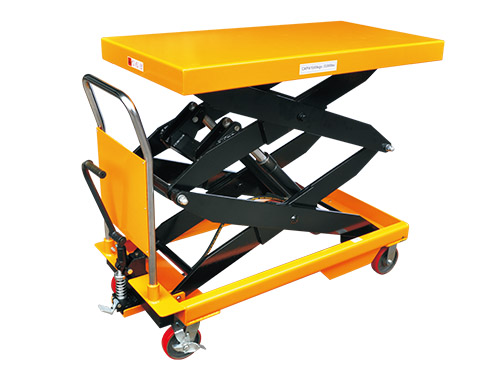
A scissor lift trolley is a mobile lifting device designed to raise and lower loads vertically using a scissor-style mechanism. Mounted on wheels, it allows operators to lift, transport, and position materials at ergonomic working heights.
Unlike fixed lift tables or overhead cranes, scissor lift trolleys offer:
- Mobility between workstations
- Flexible height adjustment
- Reduced physical strain on workers
They are widely used for repetitive lifting tasks where efficiency and worker safety are critical.
Why Scissor Lift Trolleys Matter More Than Ever in 2026
Global industries are facing increasing pressure to:
- Reduce workplace injuries
- Improve workflow efficiency
- Optimize labor costs
- Comply with stricter safety regulations
Scissor lift trolleys directly support these goals by minimizing manual lifting and improving load handling precision.
Key Drivers of Demand
- Growth of e-commerce and logistics
- Lean manufacturing practices
- Aging workforce requiring ergonomic solutions
- Increased focus on workplace safety standards
Core Design Principles of Scissor Lift Trolleys
Despite variations in capacity and power type, all scissor lift trolleys share several core design elements.
Scissor Lift Structure
The crossed scissor arms provide stable vertical movement while evenly distributing load weight.
Platform/Tabletop
Flat, reinforced platforms support cartons, components, tools, or finished goods.
Mobility System
Heavy-duty wheels—often with brakes—allow safe movement and secure positioning during lifting.
Control Mechanism
Depending on the model, lifting is controlled via hydraulic pumps or electric push-button controls.
Manual Scissor Lift Trolleys: Simple, Reliable, and Cost-Effective
Manual scissor lift trolleys remain a popular choice in 2026 due to their simplicity and durability.
How Manual Scissor Trolleys Work
These trolleys use a hydraulic pump system, operated by hand or foot, to raise the platform. Lowering is controlled through a release valve, ensuring smooth and safe descent.
Key Advantages
- No electricity required
- Low maintenance
- Cost-effective solution
- Ideal for light to medium loads
Typical Applications
- Workshops
- Production lines
- Small warehouses
- Assembly stations
Manual scissor lift trolleys are especially valuable in environments where power supply is limited or simplicity is preferred.
Electric Scissor Lift Trolleys: Efficiency with Minimal Effort
As automation and efficiency expectations rise, electric scissor lift trolleys are gaining strong momentum in 2026.
How Electric Scissor Trolleys Operate
Electric models use battery-powered lifting systems. Operators simply press “UP” or “DOWN” buttons to raise or lower the platform, while movement remains manual.
Benefits of Electric Operation
- Significant reduction in physical effort
- Faster lifting cycles
- Consistent lifting performance
- Ideal for repetitive tasks
These trolleys are widely used in environments where productivity and ergonomics are top priorities.
Comparing Manual vs Electric Scissor Lift Trolleys
Choosing between manual and electric models depends on workload and operational needs.
Manual Scissor Trolleys
- Lower upfront cost
- Best for occasional lifting
- Simple mechanical design
Electric Scissor Trolleys
- Higher efficiency
- Reduced operator fatigue
- Better for high-frequency use
In 2026, many facilities adopt a mix of both to optimize cost and performance.
Load Capacity and Height Flexibility
Scissor lift trolleys are available in a wide range of capacities, making them suitable for diverse applications.
Capacity Range
- Light-duty models for small components
- Medium-duty models for cartons and tools
- Heavy-duty models for pallets and machinery parts
Height Adjustment
Adjustable height ranges allow materials to be positioned at:
- Conveyor height
- Workbench level
- Assembly or packing stations
This adaptability significantly improves workflow efficiency.
Safety Features Designed for Everyday Use
Safety is a critical advantage of scissor lift trolleys.
Standard Safety Elements
- Stable scissor structure
- Controlled lifting and lowering
- Wheel brakes for secure positioning
- Overload protection in many models
By reducing manual lifting, scissor lift trolleys help prevent common injuries such as back strain and muscle fatigue.
Ergonomics: Reducing Worker Fatigue in 2026
One of the biggest benefits of scissor lift trolleys is their contribution to workplace ergonomics.
Ergonomic Advantages
- Loads lifted to optimal working height
- Less bending and reaching
- Reduced repetitive strain injuries
In 2026, ergonomics is no longer just a comfort issue—it’s a productivity and compliance requirement.
Applications Across Industries
Scissor lift trolleys are used across a wide range of industries due to their versatility.
Warehouses and Distribution Centers
Used for order picking, packing, and pallet handling.
Manufacturing and Production Lines
Support component transfer between workstations.
Workshops and Maintenance Areas
Assist in lifting tools, parts, and equipment.
Retail and Commercial Facilities
Ideal for stocking shelves and handling inventory.
Logistics and Assembly Operations
Improve flow efficiency and reduce handling time.
Indoor-Friendly Design for Modern Facilities
Modern facilities require equipment that works safely in finished indoor environments.
Indoor Benefits
- Compact size
- Smooth rolling wheels
- Quiet operation
- Floor-friendly designs
These features make scissor lift trolleys suitable for cleanrooms, retail spaces, and production floors.
Maintenance and Longevity
Scissor lift trolleys are known for their long service life when properly maintained.
Basic Maintenance Practices
- Inspect hydraulic systems
- Check wheel condition
- Test lifting controls
- Lubricate moving parts
Electric models also require periodic battery checks and charging system inspections.
Selecting the Right Scissor Lift Trolley in 2026
Choosing the right model depends on your operational needs.
Key Selection Factors
- Load weight
- Required lifting height
- Frequency of use
- Available space
- Manual vs electric preference
A well-chosen scissor lift trolley can significantly improve efficiency while keeping costs under control.
Global Trends in Material Handling Equipment
In 2026, global material handling trends emphasize:
- Compact equipment
- Energy efficiency
- Worker safety
- Modular, scalable solutions
Scissor lift trolleys align perfectly with these trends, making them a long-term investment for growing businesses.
The Future of Scissor Lift Trolleys
Innovation continues to improve scissor lift trolley design.
Emerging Developments
- Higher-capacity compact models
- Improved battery technology
- Enhanced safety mechanisms
- Smarter ergonomic designs
These advancements ensure scissor lift trolleys remain relevant in increasingly automated environments.
Scissor lift trolleys are commonly used for lifting and transporting goods safely. They are available in manual and electric versions, support a wide range of capacities, and are designed for everyday industrial use when operated correctly and maintained properly.
Final Thoughts
In 2026, scissor lift trolleys stand out as one of the most practical and efficient solutions for lifting and carrying materials in modern workplaces at nosteclift.com. Their compact design, flexible lifting capability, and ergonomic benefits make them essential tools across industries—from warehouses and factories to retail and logistics operations.
By reducing manual labor, improving safety, and enhancing workflow efficiency, scissor lift trolleys help businesses meet today’s operational demands while preparing for the future of material handling.
For organizations seeking a smart balance between simplicity and performance, scissor lift trolleys remain a reliable foundation for efficient, safe, and productive material movement.